
The Oppermanns
A message from 1933

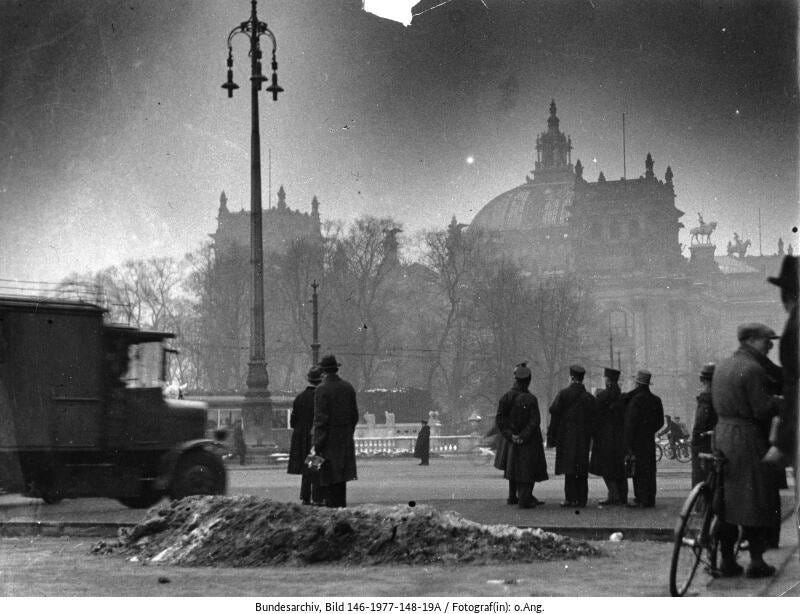
“Lies, profiteering and selfish indulgence went hand in hand. Externally, the country appeared the same as usual; street cars and autos continued to run. Shops, restaurants and theatres continued to operate. The newspapers all had the same headlines and used the same type. But internally, the country grew more barbarous, more poverty stricken, more corrupt, and more demoralized. It reeked with lies and brutality; life was fast becoming nothing but a rotten sham”.
- Lion Feuchtwanger
As a boy in the 1960’s I was fascinated with the Second World War. “WWII” was the war in which most of the parents of my generation served in some capacity. I read everything I could get my hands on about the war, mostly about the big battles, and the particulars of the tanks, planes, and ships, which I built endless plastic models of and which most of the boys my age knew all about. I couldn’t have told you much then however about why we had to use them in the first place.
As a young adult, I read more about the politics leading up to the war and the holocaust that spun up out of it. I often wondered how it was possible that a prosperous, well-educated, civil society like Germany could have transformed so quickly into the nation that sent six million European Jews to their deaths, along with the deaths of millions of others, with the apparent consent of the rest of the nation. Why didn’t they just rise up to stop it?
I didn’t really put much effort into answering, or even better understanding that question however, in part because it seemed I didn’t really need to. Never again! would the civilized world allow such a thing to happen. And for sure that would never happen in America, because after all our parents were the world’s heroes who stormed the beaches at Normandy and put a stop to the whole bloody Nazi business. Surely, we were never going to forget THAT lesson!
So rather than pursuing a PhD in the mass psychology of fascism, it was on to the more pressing, real-time issue of saving the environment for me.
And here we are in 2025. It may be too early to either name or define the political / social era we’ve entered into today, or when it started. But most of the people I know are still shaking themselves out of some level of dis-belief over how American culture and our government has shifted so dramatically, and so quickly. How far?
It seems to me that when US citizens and legal residents with no criminal record are being hauled off of our streets and out of their homes by federalized military or people in masks, never to see the inside of a court or due process, and flown out of the country to face indefinite imprisonment in places like El Salvador or Libya, then there is no fundamental guarantee of our Constitution or American civil society that can’t be broken. If they can come for them, they can just as easily come for you and me.
So a few years ago when I stumbled on Lion Feuchtwanger’s 1933 novel, The Oppermanns, I found what seemed like a graduate level course in fascist psychology that helped answer some of the questions I’d been curious about years ago, and that seem more acutely relevant than ever today.
Lion Feuchtwanger was a German Jewish writer living near Marseilles, France in the 1930’s. He began The Oppermanns in the spring of 1933, just as Hitler rose to power in January as Chancellor of the Reichstag, and he finished the book in October. In March, after the Reichstag Fire, the Nazis had already begun to suspend civil liberties and eliminate political opposition and Hitler consolidated complete power under an emergency Enabling Act that gave him the dictatorial powers he would retain until his death in 1945.
What historians like Hannah Arendt documented in 1951 with Origins of Totalitarianism, Feuchtwanger manages to capture in a story written in real time and with what now seems like almost incredible foresight. Feuchtwanger wrote later that, “I wanted to enlighten the readers of the world as soon as possible about the true face of the Nazi regime and its dangers.”
Given that Feuchtwanger was writing within months of Hitler’s rise to power, it's astonishing how accurately and eerily he was able to foretell both the character and the specifics of Germany’s descent into fascism.
The book centers on the lives of the Oppermanns, a family of prosperous and well-educated Jews in Berlin. Three brothers are heirs of a family owned furniture manufacturing business, and enjoy a seemingly enviable life of work, literature, culture, and socializing. A good life, well-earned. As the National Socialists come to power, the rights and dignity of Jews throughout the country begins to change incrementally at first, but in stages that become increasingly severe and rapid.
We’ve all learned something about that period, the lists, the persecutions, the forced relocations to ghettos, the camps, and all the horrors that followed. Here, the power of a novel, as opposed to a history, to illustrate the personal and collective ways in which people chose to respond to those events as they unfolded is brilliant.
Imagine that your life is pretty good, until you hear about a speech in which your people (or even YOU) were called vermin, or you see a notice in the paper that you’ll have to report your location to authorities, or a neighbor whispers to you that another neighbor was taken away overnight. The intense desire for normalcy that motivates most of us can be a powerful driver of disbelief, especially in times of great uncertainty.
After one such incident, the brother Gustav, a physician, says to his older brother, the business manager Martin, “I do not understand why all of a sudden you have the jitters. What has happened? A popular blockhead has been given an important office and has had a check-rein put on him by the appointment of able men as his colleagues. Do you really believe that because a few thousand young, armed ruffians roam about in the streets, this is an end of Germany?”
“Do you believe they will forbid our customers to buy from us? Do you believe your capital will be confiscated just because we are Jews? Do you believe a whole nation of 65 million people has ceased to be a cultured people because it has conferred freedom of speech to a few fools and scoundrels? I don’t believe it!”
The rationalizations of non-Jews, friends, neighbors, and co-workers, who gradually accept their own part in the system of oppression, is also insightful.
Some have clearly waited for and savored the moment when they might, for example, walk through the more desirable apartment of their Jewish neighbors and lay claim to it as their own. But most people complicit in a moral wrong find reasons to justify their correctness. “Nothing to worry about. There would be a great outward show of melodrama, but behind the scenes business would go on as usual.”
Even the growing violence, and disappearances of citizens are explainable. Yes people whispered quietly, there were a few rough doings, but in fact, things needed a little shake up and a message needed to be sent. But things would be back to normal pretty soon.
But of course, Germany was on a trajectory for which there was no going back. Which is where Feuchtwanger’s prophet-like description of Germany as it was to become in the following years is so haunting.
“There was no worse crime than the profession of reason, peace, and honorable sentiments.”
I wondered if Feuchtwanger (who died in 1958) could just as easily have written this sentence after watching Fox news, or listening to AM radio when driving through rural areas anywhere in the United States anytime during the 21st Century.
“They proclaimed that men were not equal in the eyes of the law. They locked up their adversaries, treating them worse than beasts. They banished able people from the government and the country, or locked them up in order to make room for their own incompetent adherents.”
Or could he have written this passage after having read Project 2025, and following the news from Washington for the last four months, where every one of these foretellings has been realized, not as isolated incidents but as the consistent execution of a well-planned playbook.
One of the most salient and timeless lesson from The Oppermanns, echoed by other students of autocracies like Hanna Arendt, Timothy Snyder, or Ann Applebaum, is that they don’t require the active participation of most people to succeed - they only need most people to fail to speak out and actively oppose the new regime.
Feuchtwanger was convinced that at least 2/3rds of Germans disliked the Nazis and what they stood for. But fear, lies, threats, and, for some, a promise of access to power or wealth, are enough to keep good people silent, or at least powerfully confused.
So, what would that majority of good Germans of 1933 have said to us about America today? I don’t know exactly. But if I think about times in my life that I would most like to have over again, most of them would be times when I had the opportunity to stand up and call out oppression or a wrong - whether it was in a public forum or at a hallway high-school locker - and for whatever reason I didn’t. I’m guessing their message might be along those themes, but with much higher stakes.
J.D. Vance’s recent proclamation that Christian love does not actually have to be universal, but need only extend to those closest to you, like your white Christian family, is more than an abstract idea. Legitimizing the twisted belief that Christians (or adherents to any faith) need not care for everyone, is actually necessary for an autocracy dedicated to denying the humanity or rights of a whole segment of society to succeed. Was there ever a more bankrupt idea trying to fly under the flag of Christianity?
Well, apparently yes. It shouldn’t be surprising that Vance’s effort to distort the most basic precepts of Christian theology also echoes efforts of the Nazi’s to distort Catholic and Protestant teachings to justify a belief that Jews were not capable of spirituality, and by extension, not worthy of God’s care.
The story does not end well for the Oppermann family members, who are a proxy for millions of real people like them whose lives ended in similar ways over the next decade. How could he have described this outcome so accurately? But, as the family wrestles with a horrible new reality that was scarcely believable for them just a short time before, they each confront their circumstances with a wisdom and dignity that is at least satisfying.
Maybe its time for those questions about Germany that lingered for me years ago to get restated in the now. How willing am I to be uncomfortable and how much am I personally willing to give up to protect the American democracy and the freedoms and rights our constitution guarantees? Will I be ready to stand up when the people in ICE uniforms and masks show up at my neighbor’s home? How about driving to support a neighbor 10 miles away? How about a fellow citizen, a legal resident, or an immigrant seeking asylum in another state? These don’t seem like abstract questions any longer, but they might be the questions the Germans of 1933 would ask us if they could.
Amazing read Fred! This is my fear too! I’m sharing this with all my friends!
Fred, this is an excellent (though terrifying) essay. I intend to pass it on. A thought: are you on Facebook or another social media platform? If so, please post it far and wide.